ARTWORKS
Get to know the artworks of the Echoes of Unity’s artists!
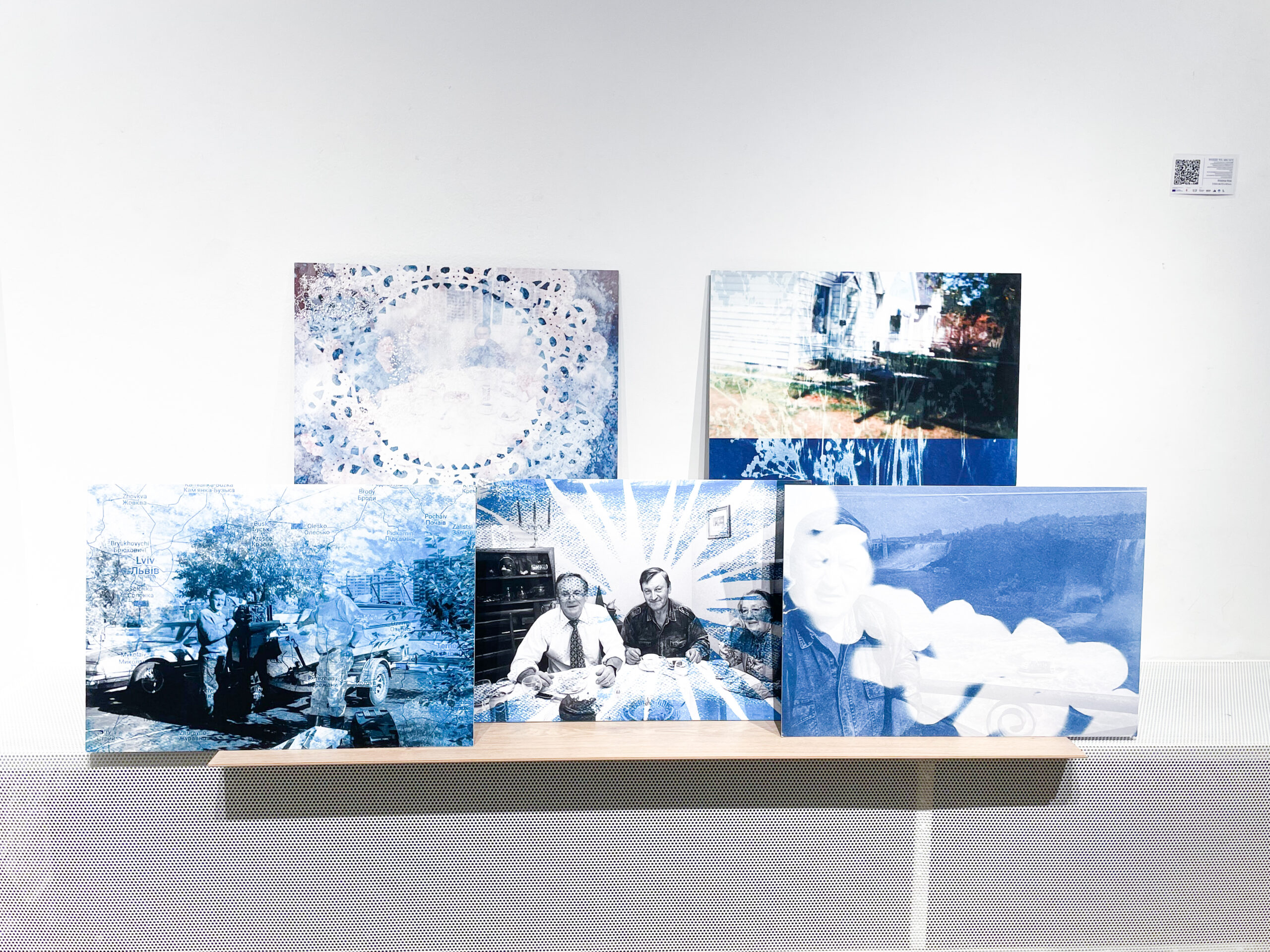
"Where we are not"
Kristina Mos
(6x) 60x42cm, 2025
cyanotype, photography, collage
500 euro per peace
AVAILABLE FOR SALE
Water dissolves memories. It transforms real events into fiction. As time progresses, our memories fade away like the water flowing behind us.
“Where We Are Not” is an ongoing project that examines the impact of migration on the experiences of various generations. The work is rooted in Kristina Mos’s family’s archive that documents her family’s journey through different phases of emigration. The narrative begins with the account of her grandfather who left Ukraine for Canada in the 1990s, progresses with the story of her mother who relocated to Italy in 2008, and culminates with the artist’s personal experience of escaping war after the full-scale invasion of Ukraine in 2022.
By employing alternative printing techniques, Mos reinterprets archival images and explores the ways in which history is remembered and conveyed. The project poses a crucial question: can these narratives unite different generations, far-off locations, varied eras, and, ultimately, humanity? In what ways does this experience shape the development of individual and collective memory? How do we recall? How do we safeguard stories, when they are being transmitted from one generation to the next?
The project “Where We Are Not” encourages us to view Kristina Mos’s photo archive not merely as a fixed collection of facts, but as a vibrant space where the personal connects with the collective, and where memory merges with artistic expression.
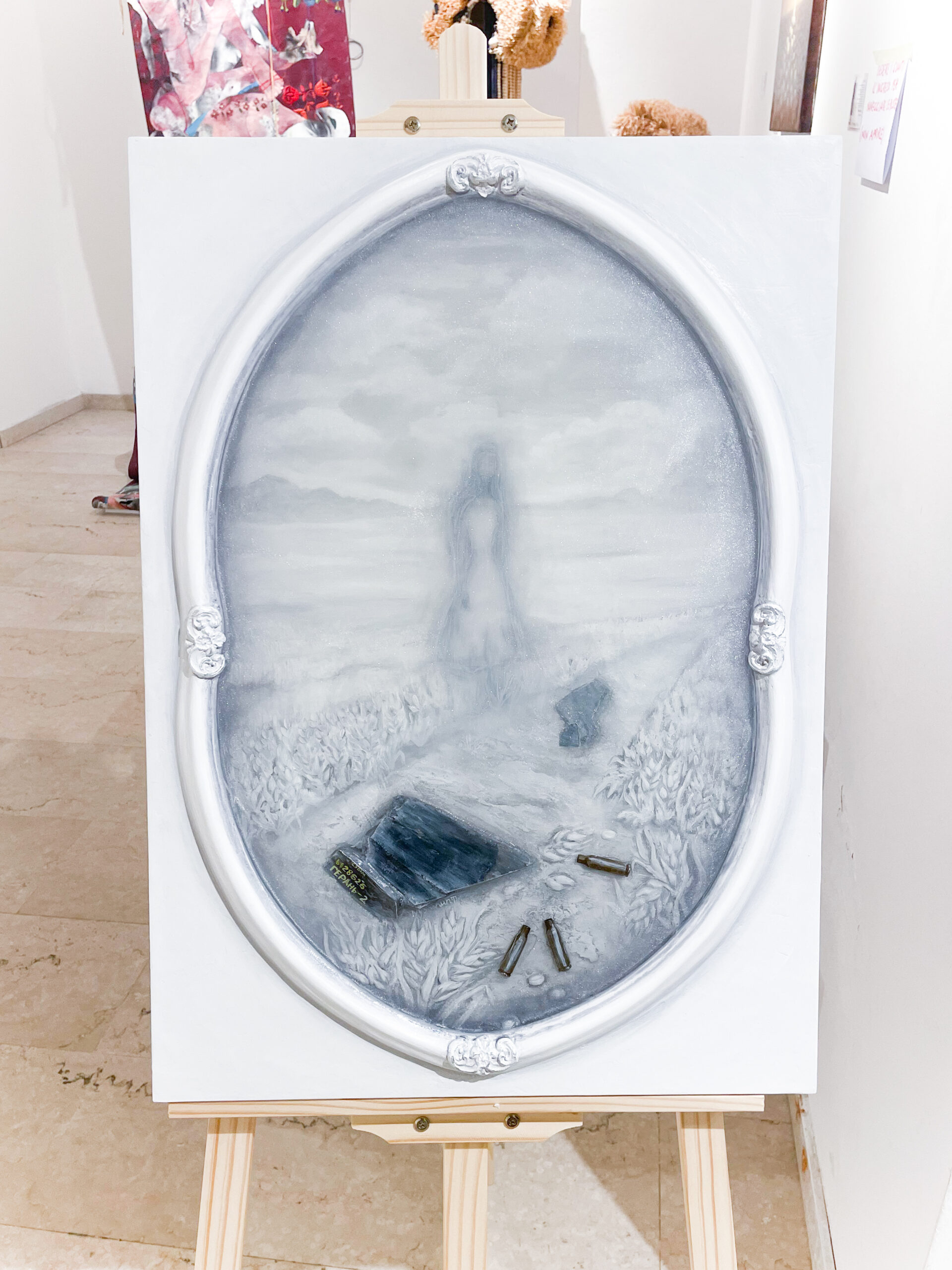
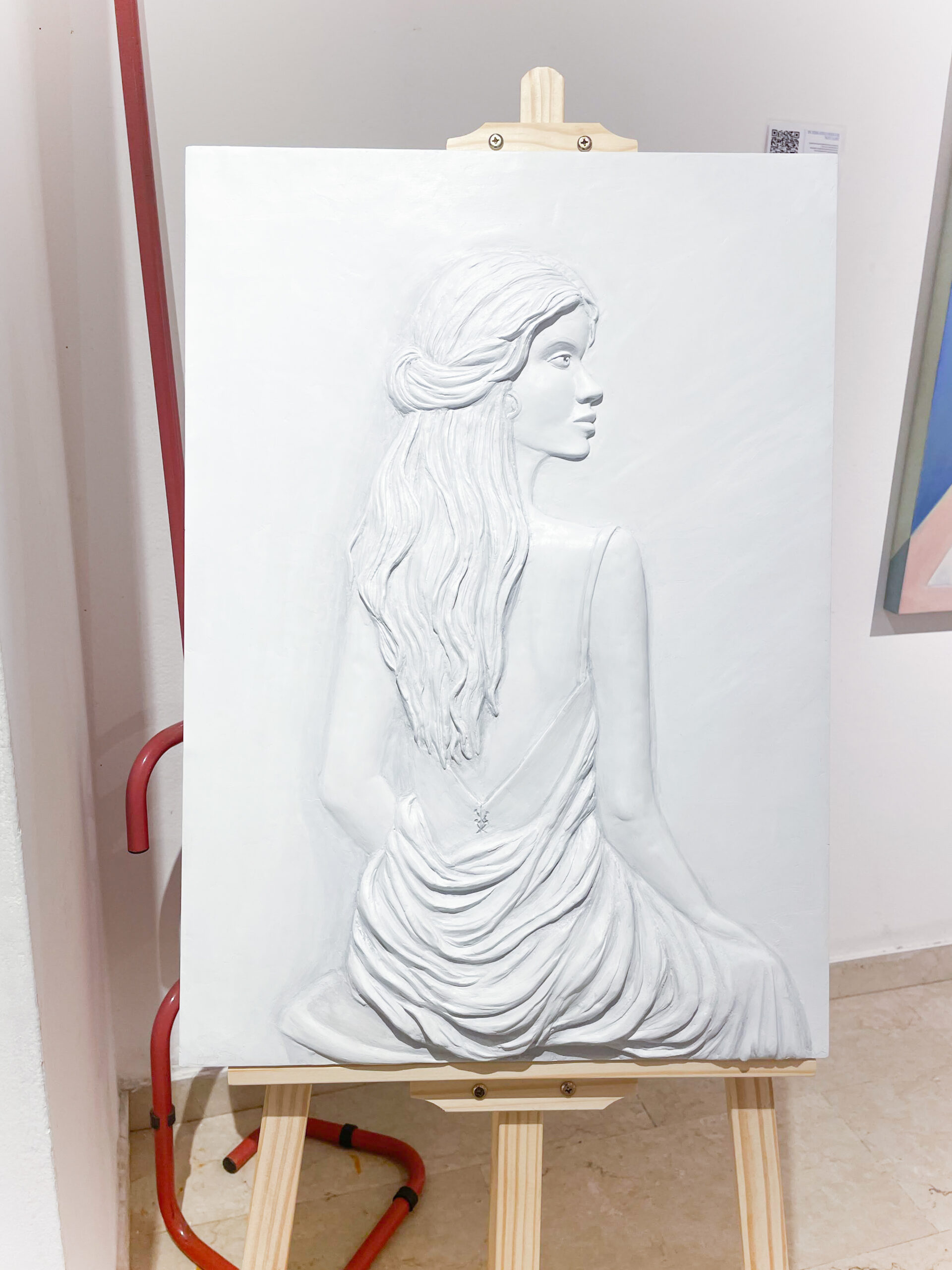
"Girl by the mirror"
Tetiana Nyshchun
(2x) 70x50cm, 2025
Wood, plaster, graphite, acrylic, resin
1500 euro
AVAILABLE FOR SALE
“Girl by the mirror” by Tetiana Nyshchun delves into the experience of exile and the challenges of self-recognition in the absence of reference points. Consisting of two panels, the artwork portrays a female figure viewed from behind as she gazes into a mirror. However, the reflection does not show her face but instead reveals an internal landscape filled with memory, trauma and loss. This piece serves as a quiet testament to the condition of being “in-between”: caught between body and absence, past and present, what has occurred and what is yet to emerge.
The diptych is created using mixed-media technique and is designed as complementary components. While they are visually and conceptually linked, they adhere to different technical processes. The first panel showcases a bas-relief carved from wood, accompanied by a pencil drawing, the application of modeling stucco, and the final painting uses gray acrylic colors that highlight depth and texture. The second panel, however, is crafted on wood with a polystyrene frame and an epoxy resin base, which produces a mirrored effect, and is enhanced by chromatic movements achieved through alcohol-based paints.
Despite the various techniques employed, the panels in “Girl by the mirror” unite in a cohesive composition where relief and reflection, solidity and transparency, physical presence and visual perception interact with one another, creating a deep and intricate visual narrative.
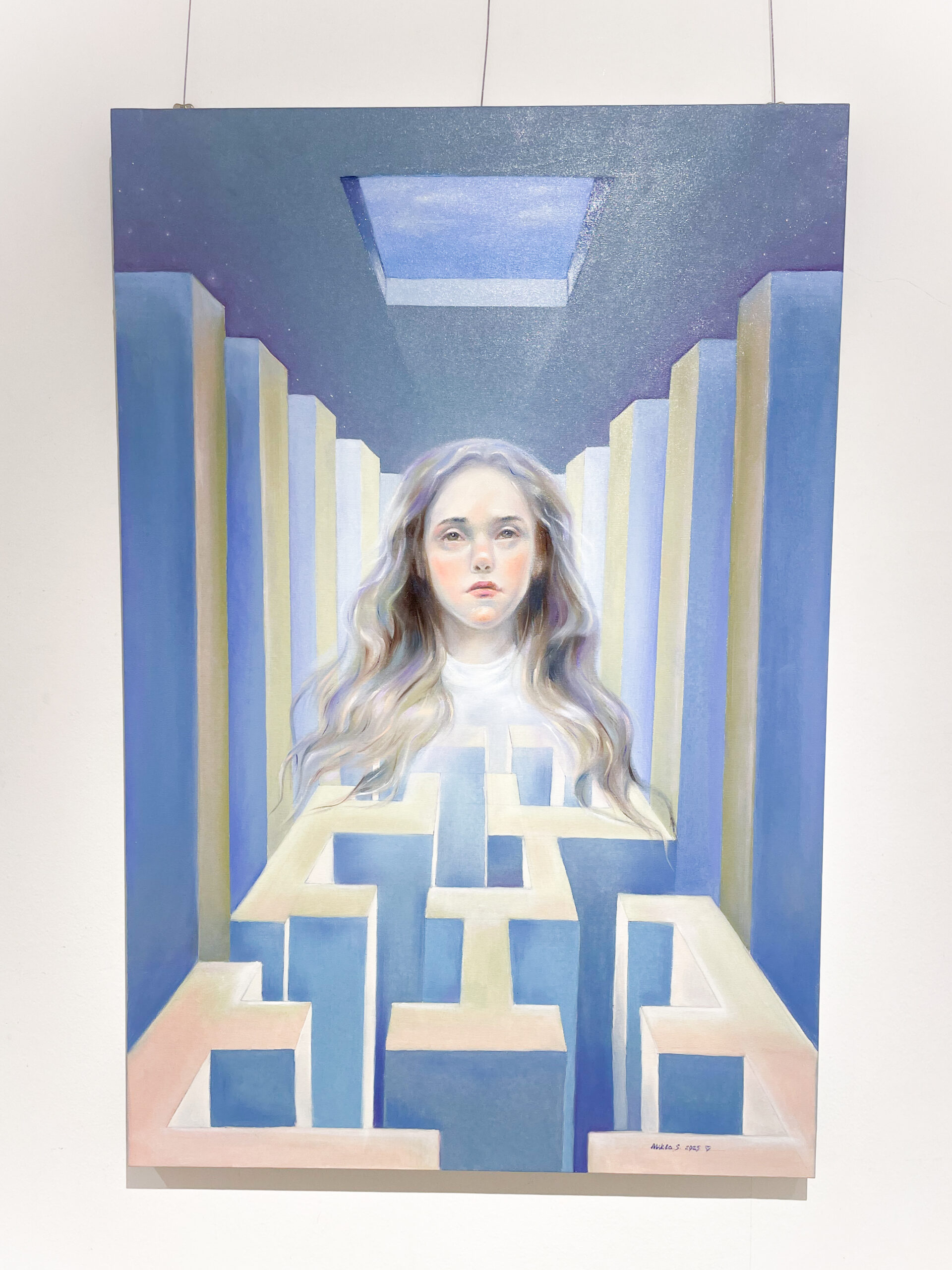
"In this stillness I’m not lost"
Susanna Mikla
120x80cm, 2025
Oil on canvas
1100 euro
AVAILABLE FOR SALE
Susanna Mikla’s artwork titled “In this stillness I’m not lost” is deeply embedded in Ukrainian cultural traditions and their modern reinterpretations. At the heart of her research lies the figure of the berehynia, a female archetype and custodian of memory, symbolizing protection, continuity and creative power. By depicting women as mothers, daughters and ancestral figures, the artist creates a visual language that weaves together myth, nature and identity.
Often, Mikla’s creations are infused with folkloric elements, ancient symbols and allusions to natural cycles, which serve as instruments to convey a collective yet deeply personal narrative. Femininity is not romanticized, but rather experienced as an ongoing process of transformation, grounded in memory and aimed at the future. Tradition is not perceived as static, but as a dynamic legacy to be reshaped and to be passed on.
The artist’s creative journey is driven by an ongoing quest to reach an equilibrium between the past and the present. Utilizing various techniques and a simplified figurative language, Susanna Mikla converts cultural heritage into a realm for both personal and communal development. Consequently, her creations evolve into sites of quiet defiance, where female memory manifests as gesture, image and continuity.
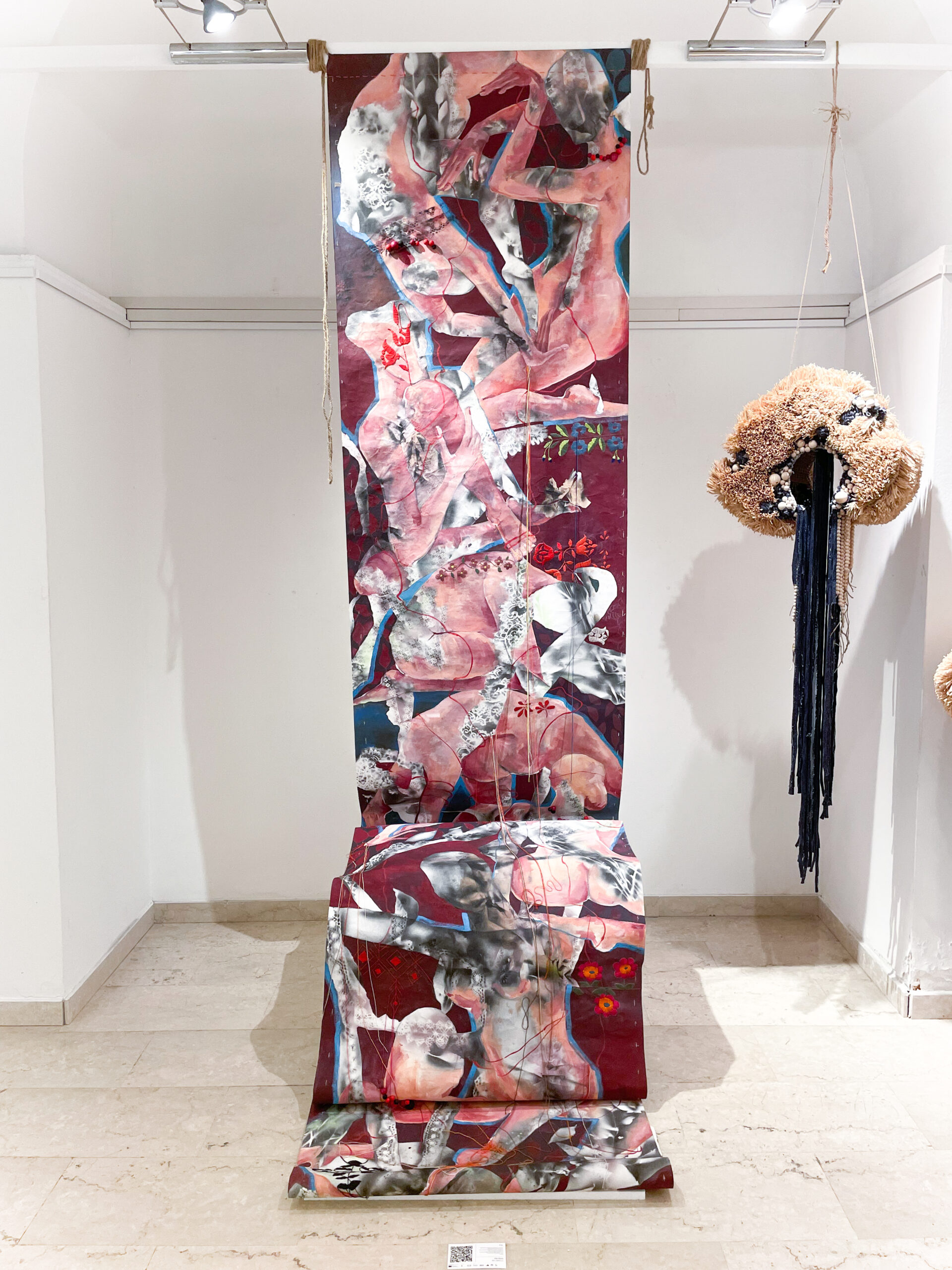
"P.S."
Aia Kora
80 × 500 cm, 2025
Canvas, paint, hand embroidery
3000 euro
AVAILABLE FOR SALE
In “P.S.”, Aia Kora approaches the canvas as if it were a living skin: sensitive, vulnerable and capable of retaining memory. It transcends the surface and evolves into an experiential space where the skin serves as a metaphor for feminine presence, inner states and memories yearning for visibility.
Female silhouettes appear on the canvas, occasionally sharply defined or at other times indistinct, as if concealed behind a delicate veil. This visual language conveys the idea of liminality: a transitional state where women inhabit a realm of continuous change, oscillating between loss and renewal.
The artwork develops piece by piece. The canvas, which measures 80 cm in width and extends up to 5 meters in length, is constructed in a sequential manner: it is stretched, experienced, altered and reworked. This process is akin to a personal diary; not intended for rereading, but for living and embodying. The acrylic backgrounds encapsulate the transient essence of moments, while the oil painted figures evolve gradually, demanding time, focus and inner growth. The embroidered elements that feature traditional Ukrainian motifs are left unfinished with loose threads. They embody codes of memory, feminine silence, suffering and unresolved wounds.
“P.S.” engages with the space and with the viewer’s body. The artwork may be suspended or positioned on the ground, which encourages a physical presence to engage in dialogue. Certain threads are deliberately left accessible to be touched, modified or transformed. As such, the viewer assumes the role of co-creator, acknowledging that no individual narrative exists apart from a shared tapestry. P.S. is an unending narrative. Like a postscript that continually contributes additional details. Like skin that always senses.
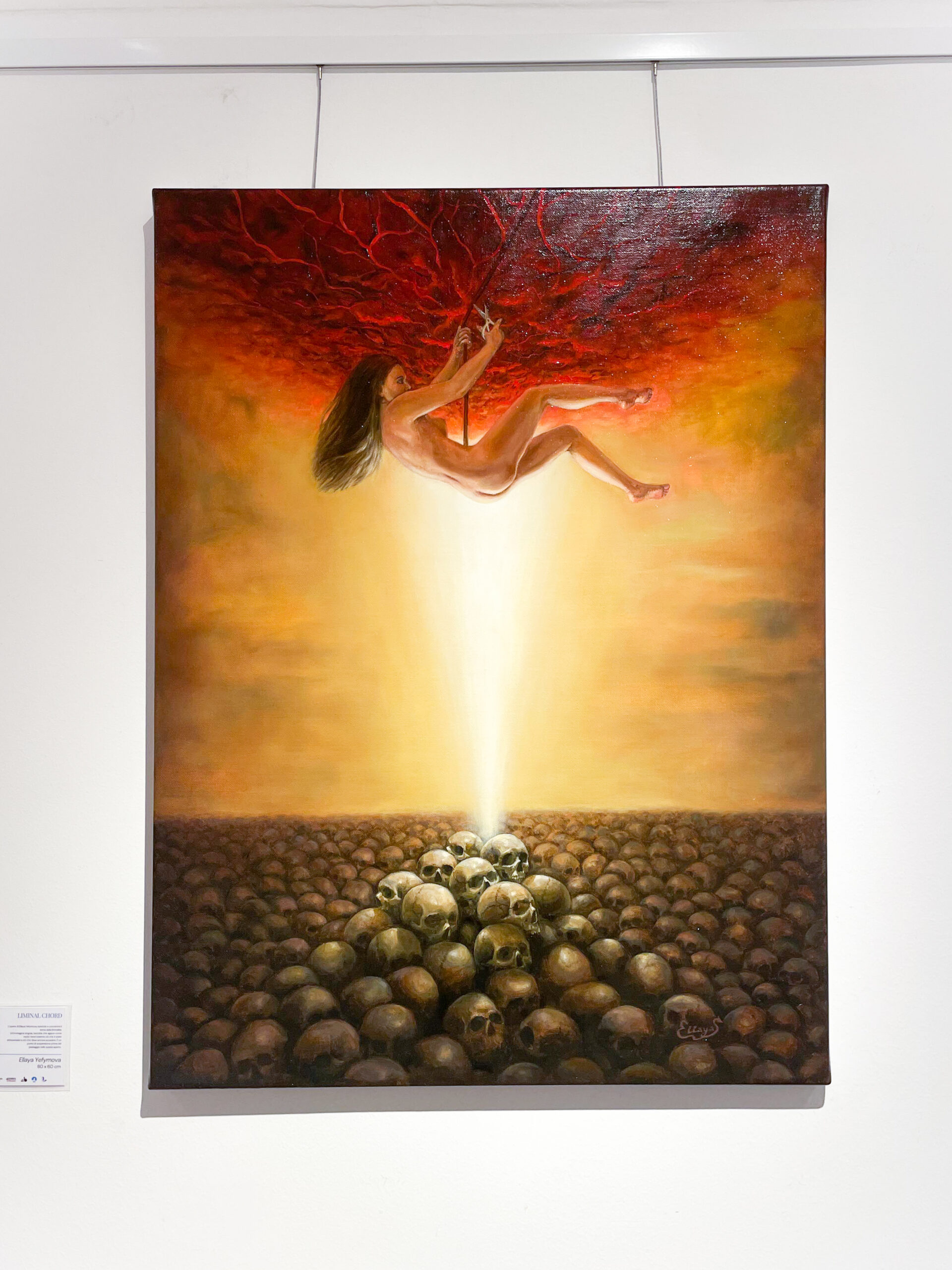
"Liminal Cord"
Ellaya Yefymova
100x80cm, 2025
Oil on linen
1800 euro
AVAILABLE FOR SALE
Following the onset of war in her homeland in 2022, Ukrainian artist Ellaya Yefymova relocated to Portugal. In 2023, after enduring a period of clinical depression, her artistic practice experienced a significant conceptual transformation, focusing on the themes of mortality and conscious existence. The painting “Liminal Cord”, arises from a liminal space—a threshold between disruption and change, where identity, meaning and stability are no longer constant. Liminality is expressed not as a fleeting anomaly, but as an essential state of being; an unstable yet productive realm, where each choice influences the subsequent stage of becoming.
Drawing from the historical tradition of Vanitas, Yefymova examines the fleeting nature of life and the certainty of death, while intentionally dismissing allegorical symbolism and romanticization. In this context, death serves as a structural boundary rather than a narrative element, a framework that heightens perception and imparts ethical significance to existence. In the painting, life is depicted as a beam of light: a focused moment between the onset of conscious identity and its eventual dissolution.
Through this conceptual perspective, the artist reinterprets the Memento Mori as Memento Vivere, suggesting that the recognition of mortality serves as a catalyst for awakening. Drawing from existentialist philosophy, the work aligns with Irvin D. Yalom’s claim that, while the reality of death may devastate us, the concept of death has the potential to liberate us. Facing our finitude transforms into a method for dispelling fear and illusion, enabling clarity, accountability and presence to emerge. Yefymova’s practice positions art as a universal language that transcends cultural and political boundaries. By emphasizing uncertainty and instability as inherent aspects of life, “Liminal Cord” encourages the viewer to reevaluate permanence as an illusion and to perceive liminality not as a disruption, but as life itself—a continuous process of becoming within finite limits.
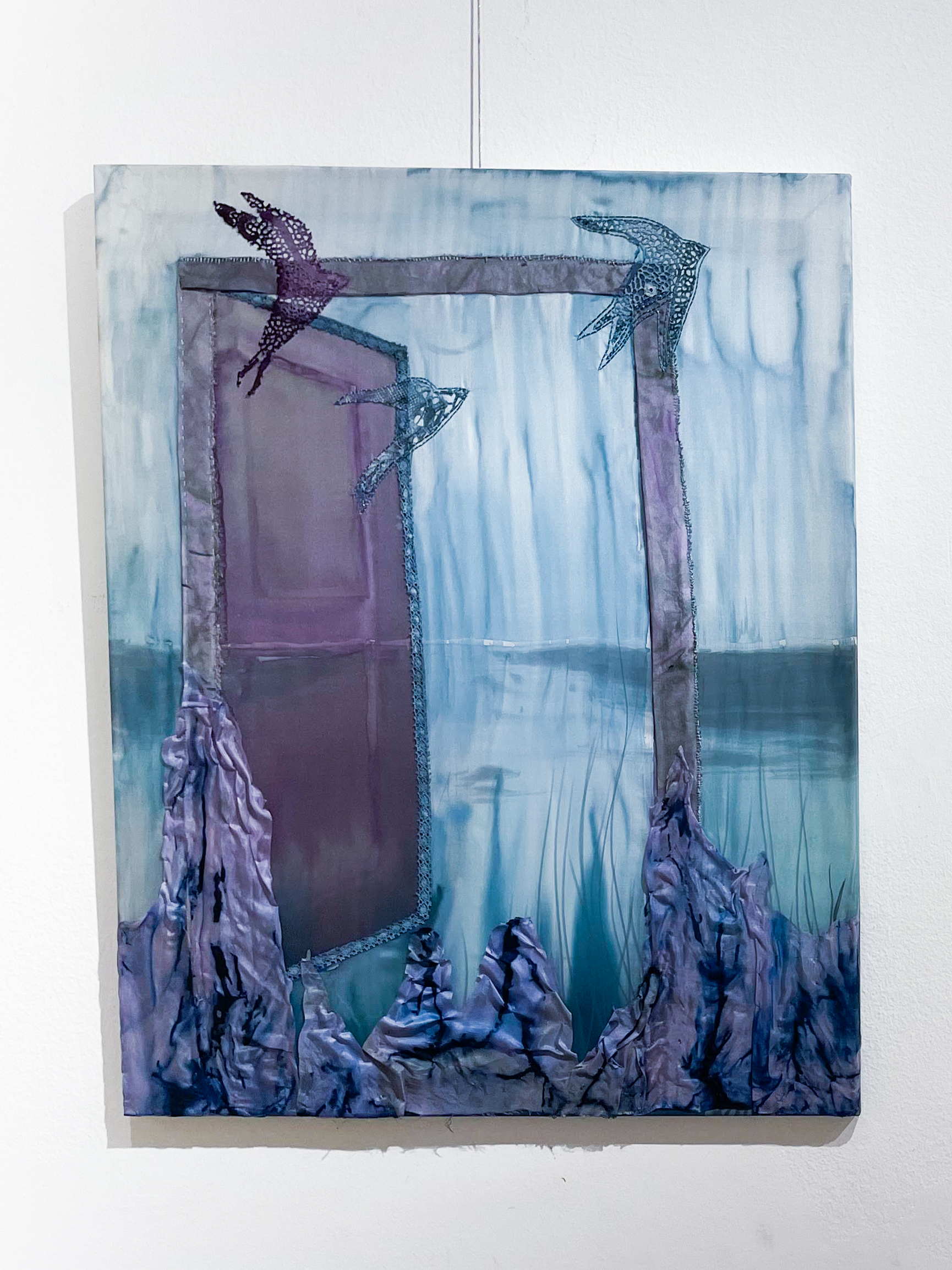
"The bare edge"
Nataliya Teslenko
(4x) 90x70cm, 2025
Mixed media on silk, embroidery, lace
1300 euro per piece
AVAILABLE FOR SALE
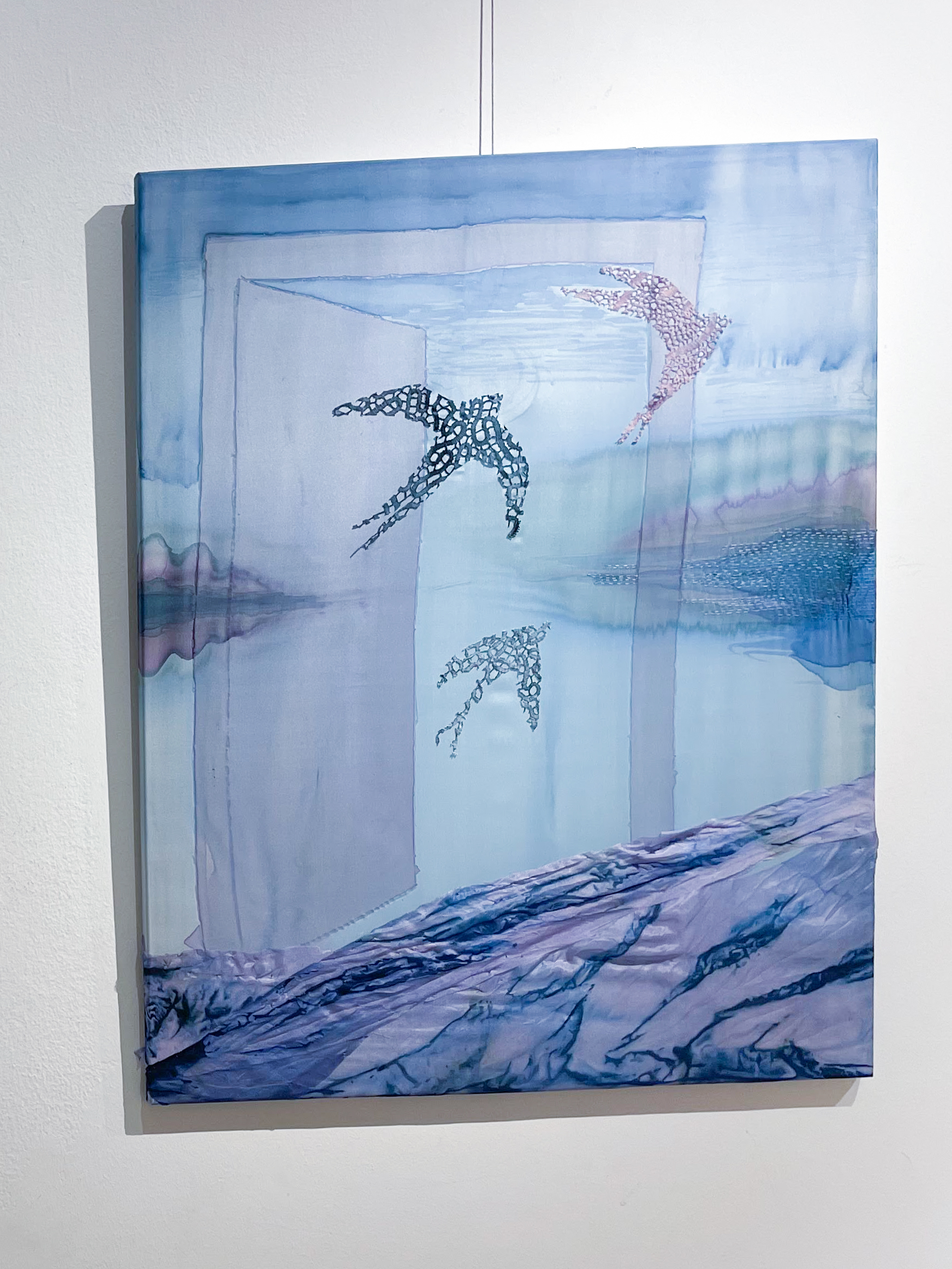
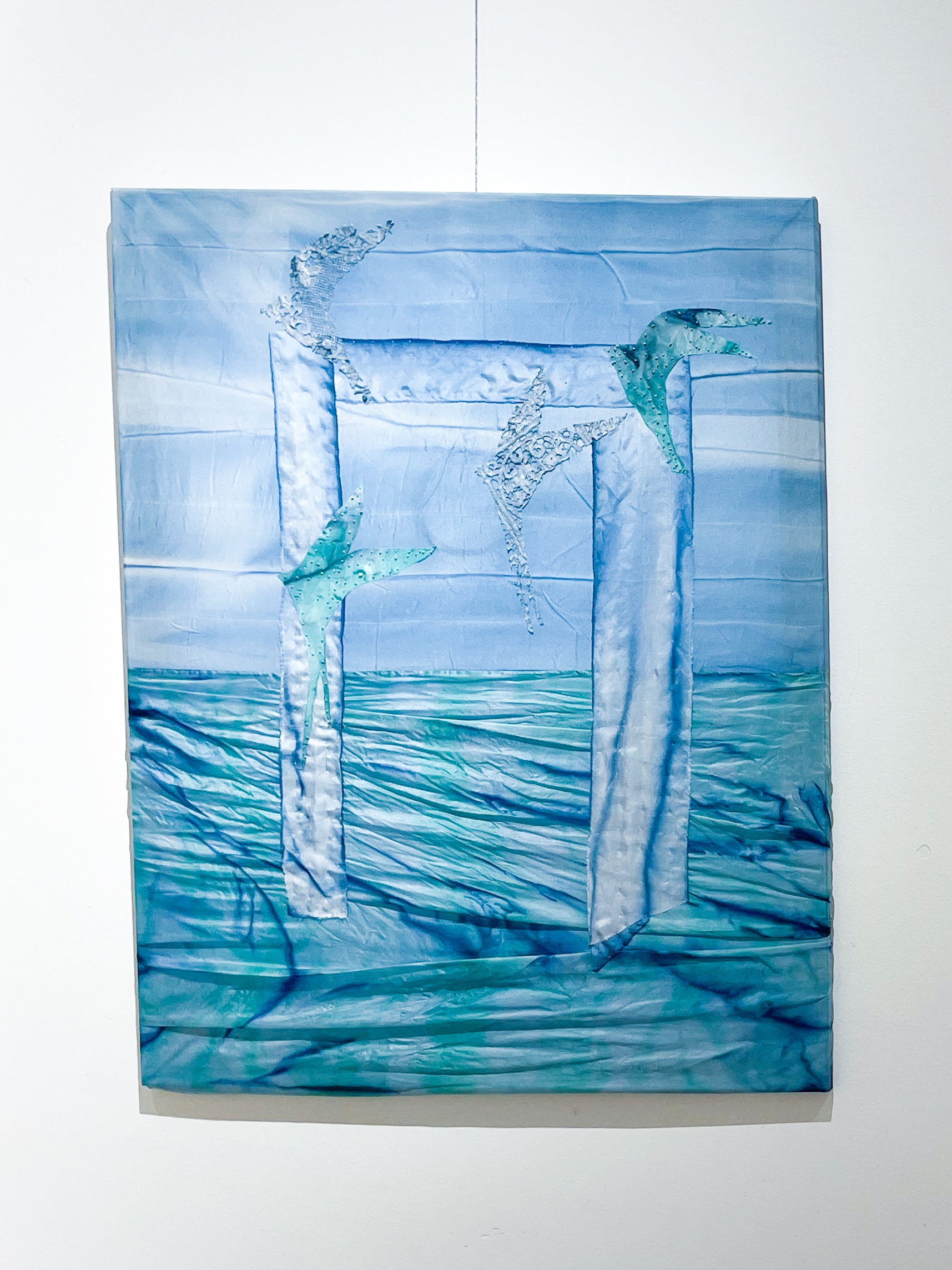
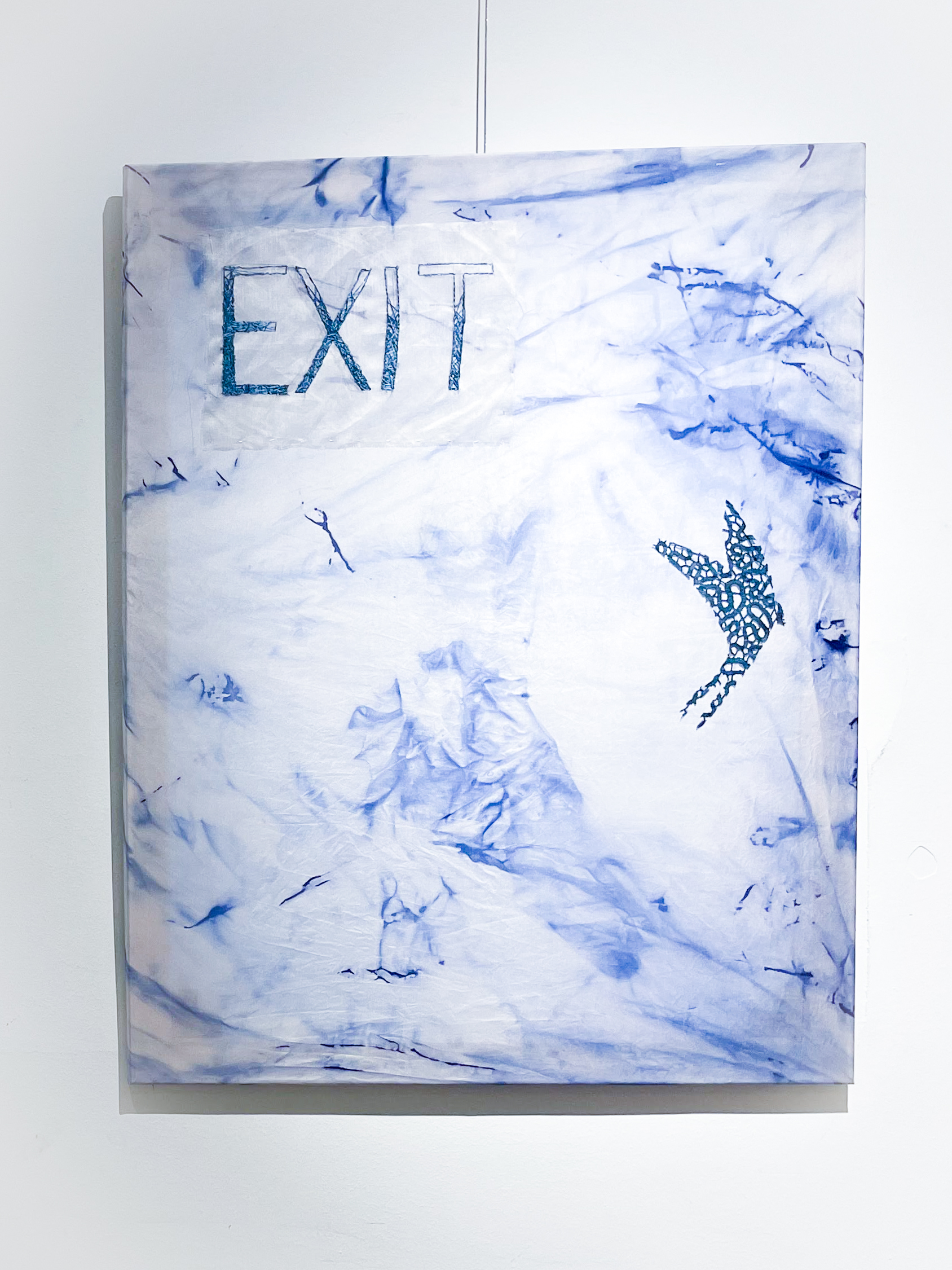
“The Bare Edge” comprises four textile panels. The works emerge from liminality not merely as a theoretical idea, but as a lived and continuous experience. Throughout the project, liminality was manifested as a lasting condition: a life defined by transition, shifting places and the perpetual quest for belonging.
The four panels represent various stages of life, each located in unstable, porous and increasingly dissolving liminal spaces. Instead of depicting fixed locations, the artworks suggest thresholds: instances of transition where identity, memory and direction are left in a state of suspension and ambiguity.
The collection consists of silk, Cantù lace and embroidery. These materials were selected for their delicacy and durability, as well as for their capacity to preserve remnants of the creative process. Cantù lace holds a pivotal position: its erratic characteristics render complete control unattainable, necessitating an instinctive and responsive methodology. Consequently, the artistic journey transforms into an ongoing dialogue with the material itself, mirroring the inherent unpredictability of transitional phases.
The silk was dyed through immersion techniques, enabling the color to develop through chance, saturation and fading. The resulting surfaces evoke emotional landscapes rather than literal images, recalling memories that transform over time and elude clarity. Swallows are depicted on the panels as symbols of migration and return. Traditionally linked with movement and orientation, swallows represent the paradox of uprootedness: the perpetual journey combined with an innate sense of home.
The silk thread embroidery creates linear, subtle marks on the fabric. These lines serve as paths, routes and remnants of memory. They do not establish boundaries but imply continuity, linking what has been left behind with what is still in the process of formation.
The intentionally revealed and incomplete edges of the artworks, provide the series with its name. These “bare edges” symbolize vulnerability, transition and the journey through unresolved liminal spaces that gradually fade away. They resist closure, favoring the process of becoming over the notion of arrival.
“The Bare Edge” contemplates migration, identity and memory as continuous processes. The series portrays liminality not merely as a fleeting threshold, but as a space of permanence, where individual and collective histories are perpetually open, layered and evolving.
"92 days"
Vlada Lobus
Various dimensions, 2025
envelopes, organizers, polaroids
92 euro per piece
AVAILABLE FOR SALE
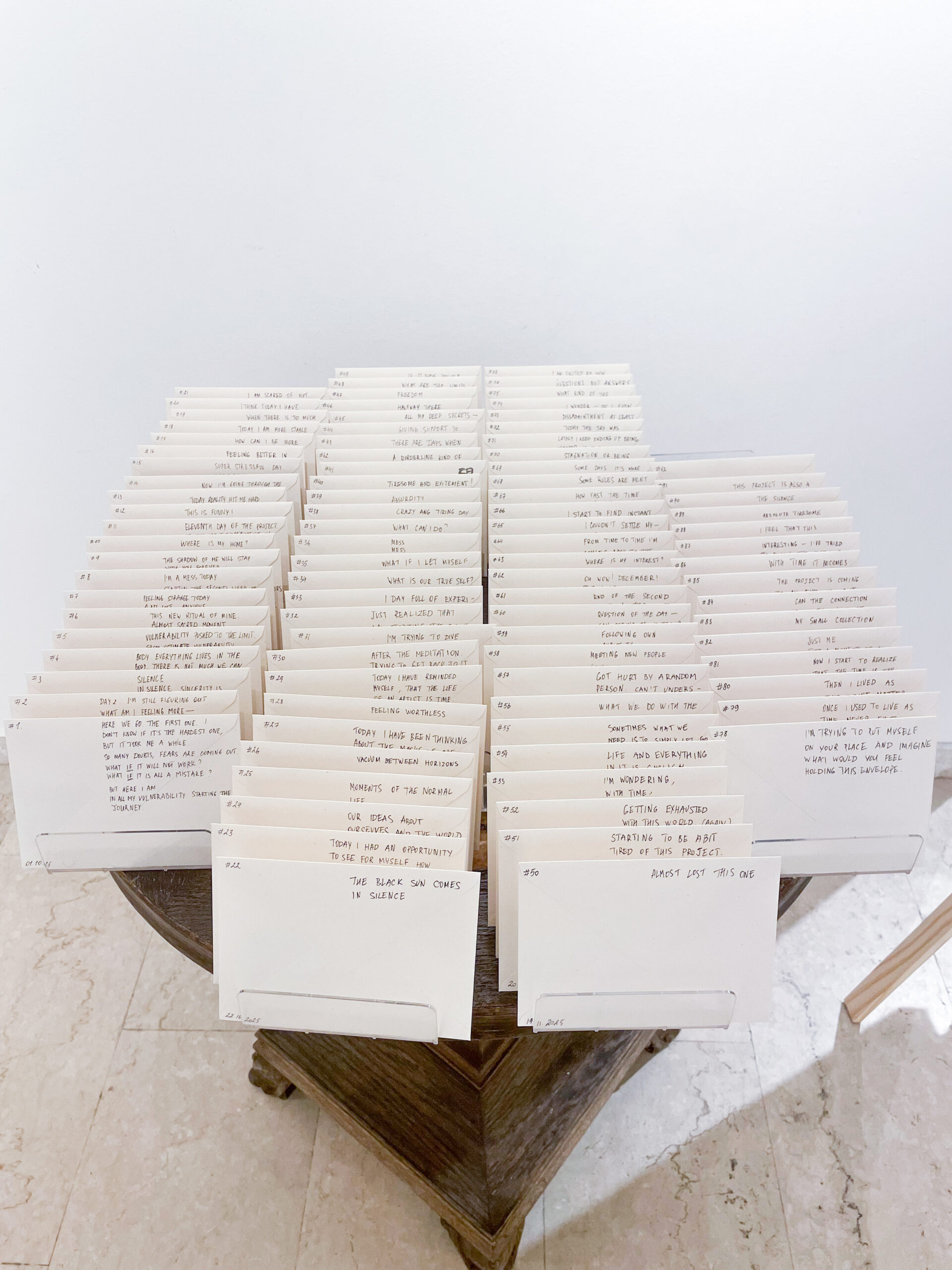
“92 Days” emerged as a contemplation of liminality and process. The project originates from the artist’s personal experiences, her academic background in psychology, and her interactions with individuals, which uncover the dynamics of uncertainty, anticipation and incompleteness. The work serves as a means to investigate these states through repetitive actions and the passage of time, turning daily practice into a form of observation and resistance.
Instant photography, often linked to rapidity, is utilized to investigate slowness and transformation. Each captured photograph is enclosed in an envelope, obscuring the image from immediate sight and emphasizing the process over the result. This profound deceleration mirrors the way life progresses day by day, devoid of shortcuts or guarantees.
The artist’s personal experiences, especially her forced migration during the war in Ukraine, have shaped her understanding of time. Existing in a realm of uncertainty has underscored the extent to which the psyche requires time to adjust to trauma. “92 Days” examines how repetition and care can serve as instruments of resilience and healing, suggesting a confrontation with finitude and impermanence.
The project spanned 92 consecutive days during which the daily practice of capturing a photograph evolved into a ritual. Each photograph, paired with a written reflection, serves as a record of experienced time, a testament to thoughts and emotions. The denial of immediate access to the image highlights the significance of the process: a challenge to the culture of immediacy, a contemplation of the importance of waiting, and uncertainty, as an essential aspect of the human experience.
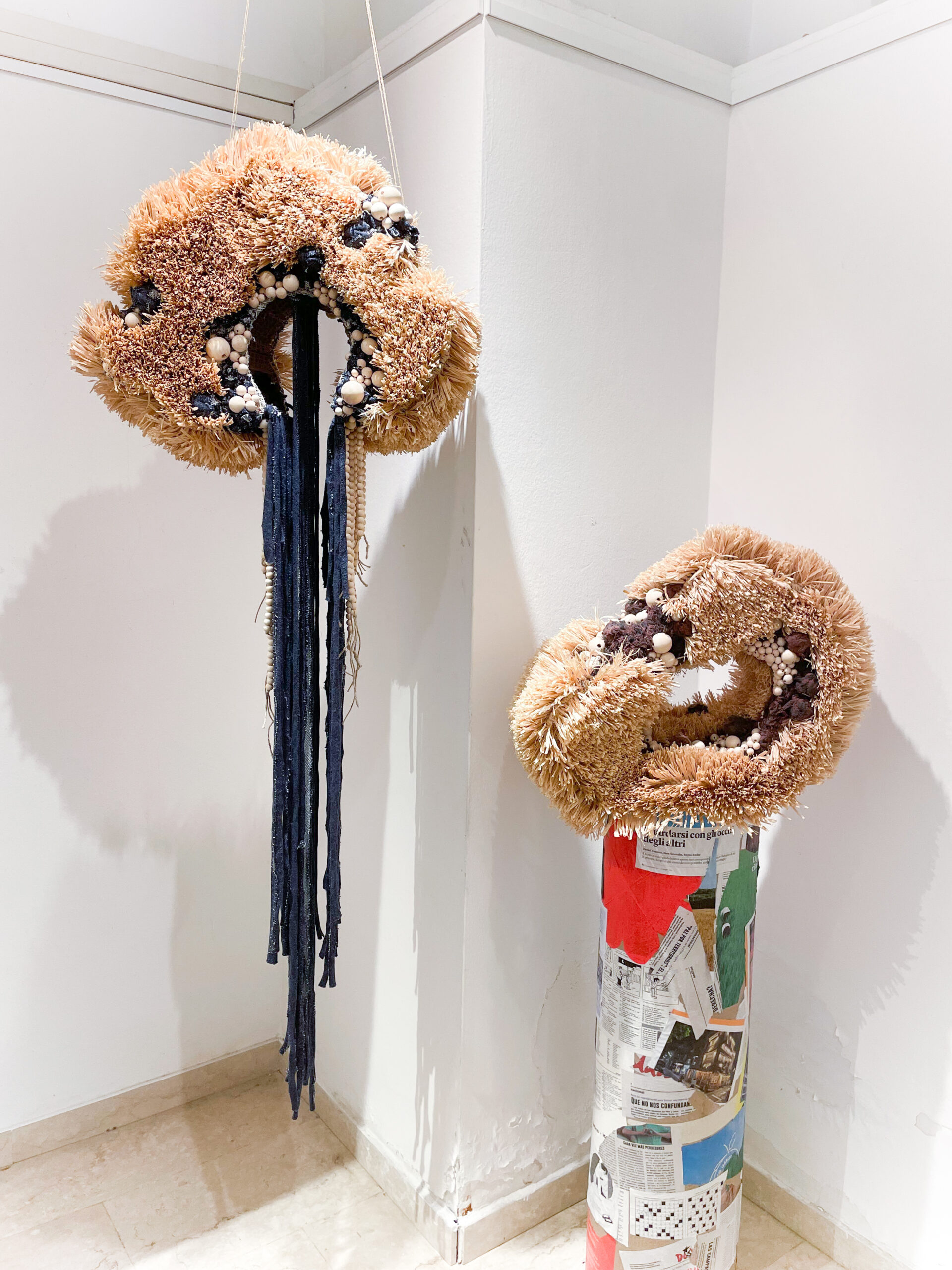
"Paradox"
Vik Shpetna
Standing: 65 × 35 × 50 cm, hanging: 65 × 35 × 150 cm
Metal wire, canvas, dry palm leaves, wooden beads, recycled cotton cords
Paradox standing 3500 euro
Paradox hanging 4200 euro
AVAILABLE FOR SALE
The artistic journey that led to the creation of Vik Shpetna’s sculptural work “Paradox” commenced with the assembly of a metal framework designed in accordance with the principles of wire sculpture, which established the form and internal tension of each piece. The framework was subsequently draped with canvas, which formed the foundation for the following manual labor. The surface was progressively built using the latch-hooking method with dried palm leaves and lower-quality recycled textiles. Certain areas of the mesh layers were created utilizing macramé techniques, enabling the materials to dangle, extend and react to gravity. The wooden beads were meticulously hand-sewn individually, acting as essential components within the structure and highlighting its tactile rhythm.
The production process extended over a period of approximately two months and demanded intense, meticulous and nearly technical labor. For around five weeks, the work persisted for 12 to 14 hours each day, with minimal breaks. After roughly 300 hours, the tracking of time ceased, as the process evolved into a continuous endeavor that was physically draining yet profoundly focused and attentive. The surfaces develop incrementally, hiding the internal structure while not entirely sealing it. The display areas provide insights into the interior structure, highlighting a state of unstable equilibrium instead of wholeness. This partial exposure is a purposeful artistic decision, representing liminality as a state lacking solid ground.
One object represents suspension, a form devoid of anchors, perpetually oscillating, as if floating in mid-air, where control is somewhat relinquished. The other signifies the illusion of stability: weighty and apparently solid, yet inherently delicate. Together, these two objects create a paradoxical conversation between movement and stillness, deceptive stability and essential risk.
The project views crisis not as an exception, but as an essential aspect of the life process. Liminal states may be uncomfortable and disorienting, yet they frequently represent crucial thresholds that enable movement and subsequent transformation.
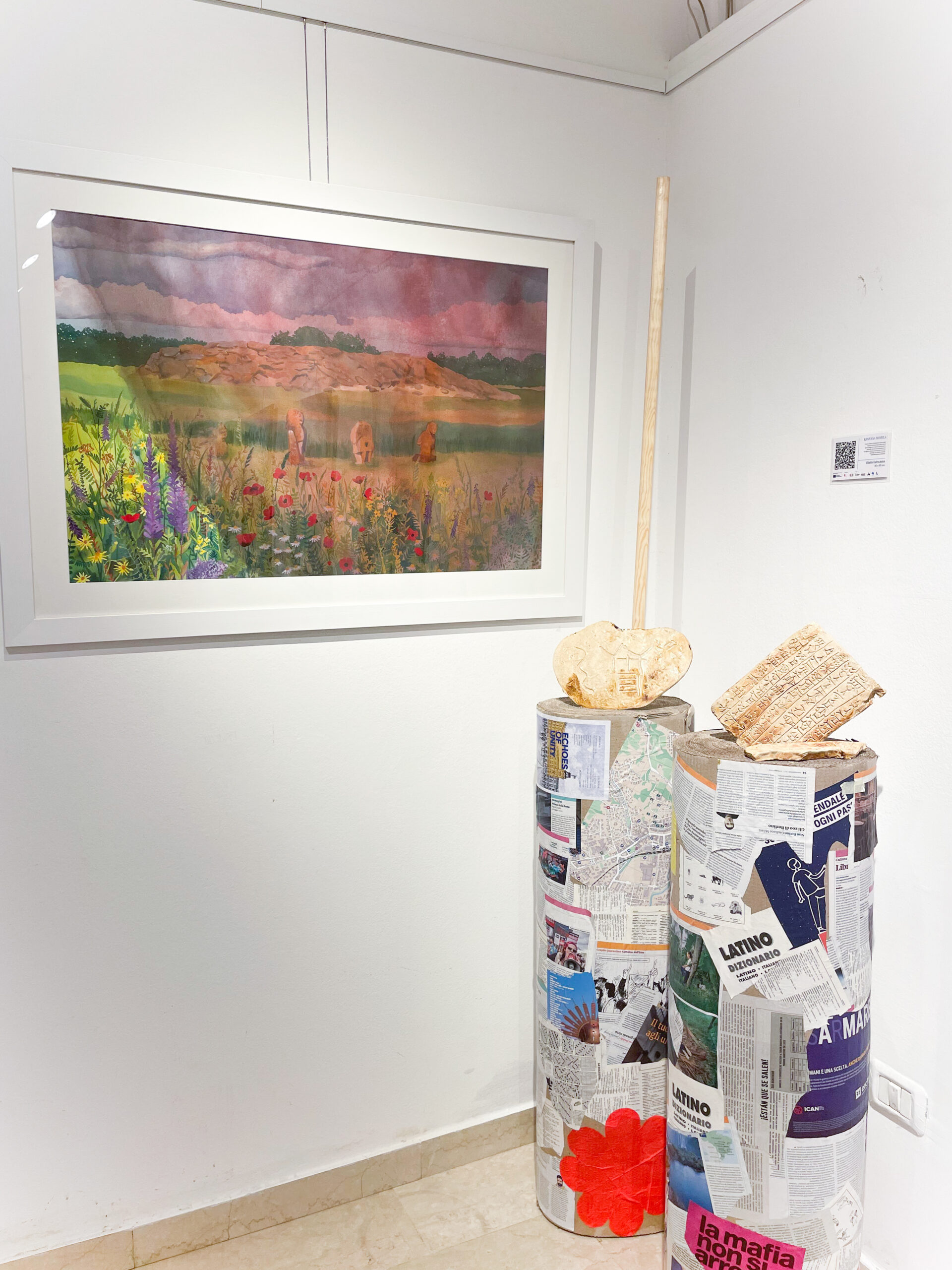
Kam’yana Mohyla. Under Occupation. Beyond Liminality
Vitaliia Kalmutska
1. Kam’yana Mohyla. Under Occupation. Beyond Liminality
60×90 cm, 2025
Archival inks on cotton paper
2. Replica of a petroglyph (proto-writing) on the wall
20×30 cm, 2025
Ceramic
3. Replica of “Rain Bull” petroglyph on the wall
20x30cm, 2025
Ceramic
4. Replica of Churinga no. 4724
7×20 cm, 2025
Ceramic
2000 euro
AVAILABLE FOR SALE
Vitaliia Kalmutska revisits the concept of liminality by concentrating on Kam’yana Mohyla (Stone Tomb); a natural location in the temporary occupied Zaporizhzhia region of Ukraine. This revered site, a geological sandstone formation, has served as a ritual landmark for thousands of years, spanning from the Paleolithic era to the present. The site represents the enduring nature of the Earth amidst the transience of human existence.
Although the artist never visited Kam’yana Mohyla in person, her bond with the location is profound, largely through her friend Anya’s photographic archive. Currently, the occupation has rendered this landscape even more liminal, altering a sacred and natural environment into an uncertain and perilous territory. The darkness depicted in the film’s images embodies the same sense of loss and non-existence that the artist felt during the onset of the war, when she was trapped with her children in the partially occupied Bucha.
Vitaliia Kalmutska’s project “Kam’yana Mohyla. Under occupation. Beyond liminality” features three sculptures that uncover the essence of the historical site’s cave, representing the devastation caused by war and occupation. One sculptural component represents a Churinga (prehistoric, engraved sandstones), one of many sacred artifacts that were stolen from the Melitopol museum, which, in the context of Kalmutska’s work, symbolizes historical violence and the erosion of cultural heritage.
The artwork of Vitaliia Kalmutska not only delves into the historical memory of the Ukrainian people and culture but also mirrors the conditions of uncertainty and transformation encountered during wartime, where the past and the future converge on a “border” that provides no certainties.